 Good News about the Old World.
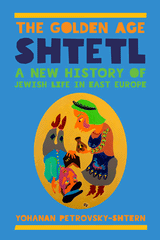
Petrovsky-Shtern, Yohanan. The Golden Age Shtetl: A New History of Jewish Life in the Shtetl. Princeton, NJ: Princeton University Press, 2014.*
Where is your family from? If you’re an Ashkenazi Jew with relatives who immigrated before the first world war, chances are they were born in a shtetl with memories of poverty and fear.
As a young girl, Vera tried to figure out the connection between herself and “those people” from Sholom Aleichem’s stories. Reading The Golden Age Shtetl solved the puzzle for me of the roots of women like Vera and Alisa, my vibrant capitalist friends who seemed to embody centuries of business know-how --- skills that were anathema to the Russian Orthodox church.
To unlock this thriving time in the shtetl, one must turn back the pages of history before 1881 ,the first pogrom, long before Sholom Aleichem’s Tevye was forced by the Russian government to abandon his beloved Anatevka. In fact, we’d need to move all the way back to the last decade of the 18th Century. Petrovsky-Shtern refers to the period from 1790-1840 as “the golden age” of the shtetl.
Meryll was already familiar with Petrovsky-Shtern before I met him at my cousin’s house last month [see blog on “Driven Crazy by Putin...”]. When Vera mentioned her family’s centuries-long tradition of military service, Meryll turned to Petrovsky-Shtern’s earlier book, Jews in the Russian Army 1827-1917. Our family adopted a different strategy from Vera's regarding the Russian Army – Get adopted by a family as their oldest son or run away or both!!!
Back to the golden age shtetl. According to Meryll, Jews did best when they did not live under centralized powers. During this time frame, Russia had not yet fully encroached on the previous Polish land and many of the cities were still under the rule of Polish landlords. Petrovsky-Shtern states that 80 percent of East European Jews, two thirds of world Jewry, dwelled in shtetls at this time in Eastern Europe. Under Catherine the Great, Russia annexed eastern Polish territories and inherited about one million Jews.
Although the history of the Jews in Russia dates to the first centuries of the Common Era, when Jews established trading ports along the Crimean shore (perhaps it should be called New Palestine, not New Russia), the legacy that permeated the shtetl came from European Jews. These Jews, expelled from Western and Central Europe during the Inquisition, were welcomed as skilled tradesmen and merchants to develop the estates of their Polish landlords.
During the fifty year era from 1790’s to the 1840’s, the shtetl buzzed with vibrant and cosmopolitan life. The Jews had an obligation to organize and operate trade fairs. They were manufacturers, innkeepers, traders in liquor, and owners of printing presses. Literacy was high. This was concurrent with the majority of the surrounding non-Jewish population enslaved as serfs and illiterate.Jews were the intermediaries between urban and rural areas and with the occurrence of trade fairs could exchange news and information easily. Petrovsky-Shtern compared Jewish trade at this time to an “all-in-one department stores.” According to Petrovsky-Shtern, the golden age shtetl was not a ghetto, but a world where Jews, Poles, Ukrainians and Russians interacted. He describes Russian soldiers being sheltered at Jewish inns, which actually lent security to the towns and fostered understanding between the troops and their hosts. Petrovsky-Shtern describes regional differences among the shtetls. For example, Central Ukraine was the hotbed of Hasidism, a radical movement at the time.
So here is the missing link. Vera and Alisa's independent and entrepreneurial spirit might have emerged as a legacy of this era. “The Jewish shtetl was patriarchal in men’s imaginations only. The golden age shtetl was entirely matriarchal.” (p. 219). The author describes women as the “key decision makers [who] assumed responsibility for bartending and cooking, protecting and renovating their real estate, litigating in courts, and trading in the marketplace and home stores.” He explained that because of their partnership role with their husbands,women were more independent than their Slavic neighbors. The divorce rate in the 1840’s was estimated by Petrovsky-Shtern to be between 25 and 50 percent. It wasn’t simply equality that threatened the family. Jewish tradesmen were frequently gone for long periods of time. In addition, once the family left the shtetl and moved to urban areas, they seemed to be more at risk for assimilation, a further threat to the family structure.
It was difficult to preserve Jewish tradition in the cities, and indeed many Jews chose not to. The author mentions that Marc Chagall’s mentor, Yehudah Pen, known for his depiction of shtetl life, offered a warning of lost traditions. One motif was an elderly couple sitting at a Shabbat table with no one there to carry on the tradition. This is reminiscent of Alisa describing the Passover celebration at her Leningrad home where her family knew that on this Jewish holiday they were supposed to have a special meal and eat matzah, but could no longer remember the seder service or how to read the Hebrew words.
What destroyed this vibrant life of the shtetl? Our family would shout out in unison "Cossacks", referring to those who were said to pillage the towns in seasonal riots. Petrovsky-Shtern blamed fires as the major culprit even before the pogroms. The fires seemed to be a result of dry climate, rather than arson.
Petrovsky-Shtern’s The Golden Age Shtetl, opens a treasure-trove of primary resources that only this multi-lingual and gifted history professor could translate with such rich context. He's also a wonderful artist and designed the cover. Enjoy the book, but remember, as Grandma Rae taught us, beware of the Cossacks. They may return.
*Yohanan Petrovsky-Shtern was awarded the Gerrard and Ella Berman Memorial Award from the National Jewish Book Awards 2015. And we recommended The Golden Age Shtetl months before the award was announced.
**March 23, 2015: Yohanan Petrovsky-Shtern will be exhibiting at the Ukrainian Museum in New York City. See the poster below minus the artwork.
Exhibition Tales and Myths
Art works by Yohanan Petrovsky-Shtern
Join us for the opening reception
Sunday, March 29, 2015 at 2 p.m.
Meet the artist!
Can one combine primitive art and biblical theology, the laconic style of posters and deep insight into human nature? In the exhibition Tales and Myths Petrovsky-Shtern brings together the color of East European avant-garde, the warmth of Ukrainian folk painting, and the message of traditional Jewish texts. Explore how the Jewish and the Ukrainian visual images come together to tell a story of human kindness, defenselessness, and vulnerability.
Vasyl Makhno, a poet and writer, is guest curator for Tales and Myths.
Visitor information: