
 Featured book for August
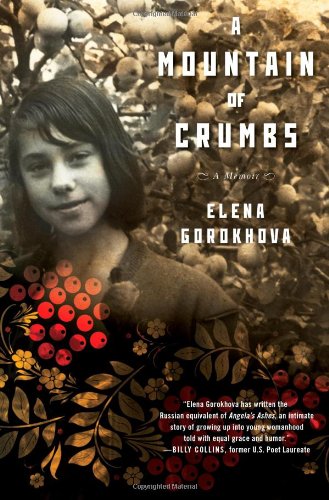
Elena Gorokhova: A Mountain of Crumbs
Why you might be interested:
Leslie and I became voracious readers of Russian emigrants’ memoirs before we wrote Jewish Luck. We wanted to make sure that Vera and Alisa’s memoir added something new to the body of literature and we were interested in seeing how Russian authors presented their culture to a non-Russian audience.
One of the most gripping memoirs we read was A Mountain of Crumbs by Elena Gorokhova. Like Alla and Vera, Elena is Leningrad born. Although she is older than Alla, she attended the same English language school, #238. Elena, however, is not Jewish but she shares a disdain for the vranya (deception) of Soviet life with Alla and Vera.
Gorokhova’s language is lyrical, and it’s clear from her voice that she has mastered the nuances of the English language. We were hooked as soon as we read...
Featured book for August
Elena Gorokhova: A Mountain of Crumbs
Why you might be interested:
Leslie and I became voracious readers of Russian emigrants’ memoirs before we wrote Jewish Luck. We wanted to make sure that Vera and Alisa’s memoir added something new to the body of literature and we were interested in seeing how Russian authors presented their culture to a non-Russian audience.
One of the most gripping memoirs we read was A Mountain of Crumbs by Elena Gorokhova. Like Alla and Vera, Elena is Leningrad born. Although she is older than Alla, she attended the same English language school, #238. Elena, however, is not Jewish but she shares a disdain for the vranya (deception) of Soviet life with Alla and Vera.
Gorokhova’s language is lyrical, and it’s clear from her voice that she has mastered the nuances of the English language. We were hooked as soon as we read... 
 Simon Sebag Montefiore (b. 1965) doesn’t need us to trumpet his achievements, but in case you haven’t read all his books, I thought I’d mention this versatile author who has written both history and fiction. The common thread among his books is Russia. (except for the book, Jerusalem, which I intend to read before my next trip to Israel in November).
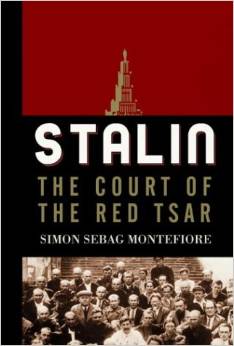
I read The Court of the Red Tsar for an International Baccalaureate Teacher’s Seminar over a decade ago. All of us history teachers were fascinated by his extensive research. It seemed like once the archives in Russia opened in 1994, Montefiore hopped on the first flight to the FSU ready to take notes. The Court of the Red Tsar dazzles history teachers-and anyone else who reads it- with new details about Stalin’s rule and his control over his ministers. His prose flows and most of us IB History teachers decided...
Simon Sebag Montefiore (b. 1965) doesn’t need us to trumpet his achievements, but in case you haven’t read all his books, I thought I’d mention this versatile author who has written both history and fiction. The common thread among his books is Russia. (except for the book, Jerusalem, which I intend to read before my next trip to Israel in November).
I read The Court of the Red Tsar for an International Baccalaureate Teacher’s Seminar over a decade ago. All of us history teachers were fascinated by his extensive research. It seemed like once the archives in Russia opened in 1994, Montefiore hopped on the first flight to the FSU ready to take notes. The Court of the Red Tsar dazzles history teachers-and anyone else who reads it- with new details about Stalin’s rule and his control over his ministers. His prose flows and most of us IB History teachers decided... 
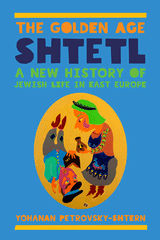 Good News about the Old World.
Petrovsky-Shtern, Yohanan. The Golden Age Shtetl: A New History of Jewish Life in the Shtetl. Princeton, NJ: Princeton University Press, 2014.*
Where is your family from? If you’re an Ashkenazi Jew with relatives who immigrated before the first world war, chances are they were born in a shtetl with memories of poverty and fear.
As a young girl, Vera tried to figure out the connection between herself and “those people” from Sholom Aleichem’s stories. Reading The Golden Age Shtetl solved the puzzle for me of the roots of women like Vera and Alisa, my vibrant capitalist friends who seemed to embody centuries of business know-how --- skills that were anathema to the Russian Orthodox church.
To unlock this thriving time in the shtetl, one must turn back the pages of history before 1881 ,the first pogrom, long before Sholom Aleichem’s Tevye was forced by the...
Good News about the Old World.
Petrovsky-Shtern, Yohanan. The Golden Age Shtetl: A New History of Jewish Life in the Shtetl. Princeton, NJ: Princeton University Press, 2014.*
Where is your family from? If you’re an Ashkenazi Jew with relatives who immigrated before the first world war, chances are they were born in a shtetl with memories of poverty and fear.
As a young girl, Vera tried to figure out the connection between herself and “those people” from Sholom Aleichem’s stories. Reading The Golden Age Shtetl solved the puzzle for me of the roots of women like Vera and Alisa, my vibrant capitalist friends who seemed to embody centuries of business know-how --- skills that were anathema to the Russian Orthodox church.
To unlock this thriving time in the shtetl, one must turn back the pages of history before 1881 ,the first pogrom, long before Sholom Aleichem’s Tevye was forced by the...